Showing posts with label synapse. Show all posts

Sunday, September 18, 2022

Neurotransmitters

Neurotransmitters are small molecules that carry messages among axons and between the nervous system and other tissues and organs. They are chemical messengers by which neurons communicate with each other. High

Neurotransmitter carries, boosts, and balances signals between neurons (nerve cells) and target cells throughout the body. These target cells may be in glands, muscles, or other neurons.

Network of nerves 0r nervous system controls everything from human mind to his muscles, as well as organ functions. In other words, nerves are involved in everything human being do, think and feel.

Some common neurotransmitters in the brain and body include serotonin, dopamine, glutamate, epinephrine, norepinephrine, and endorphins.

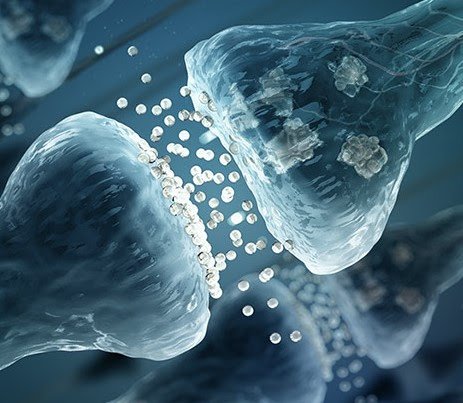
Neurotransmitters are located in a part of the neuron called the axon terminal. They’re stored within thin-walled sacs called synaptic vesicles. Each vesicle can contain thousands of neurotransmitter molecules.

When stimulated, the vesicles merge with the cell membrane of the presynaptic cell, and the neurotransmitter is released into the synapse, or “synaptic space.” The target cells contain receptors where the neurotransmitters can bind and trigger changes in the cells.
Neurotransmitters
Saturday, December 12, 2015

What is synapse?

The synapse is the structure that mediates the effects of a nerve impulse on a target cell, permitting communication among nerve cells, muscles and glands.  It is contact point where information is transferred. Usually, synapses are made between the axon of a presynaptic neuron, the sender and the dendrite of a postsynaptic neuron, the receiver.

There are two types of synapses electrical synapses and chemical synapses. Chemical synapses may act either directly through ion channels or indirectly through second messengers.

A single neuron can have up to approximately 10,000 synapses. Changes in the number and strength of synapses, called synaptic plasticity are thought to be biological mechanism of all learning and memory.

Defining the presynaptic specialization is a cluster of synaptic vesicles ( ~40 nm diameter) containing neurotransmitters, some of which are closely associated with a thickening of the presynaptic plasma membrane, called the active zone.

Messages arrive at the synapse in the form of action potentials. Synaptic potential are triggered by action potentials; they in turn trigger subsequent action potential, continuing the neural message on to its destination.
What is synapse?

The most popular Articles

BannerFans.com BannerFans.com